
Let's talk about what we're actually hearing.
You don't need to know music theory or how a spectrum analyzer works. I didn't start this project because I wanted to teach a physics class. I started because I had questions—and the answers turned out to be pretty interesting.
Close enough for music isn’t always close enough for frequency.
When most of us make music, we work with a familiar set of notes. On a modern piano tuned to the usual standard, each key has a particular pitch.
But the frequencies people talk about in frequency-focused music don't necessarily match those pitches. Take 285 Hz. The nearest conventional piano note is about 277.18 Hz. That's close in musical terms—but it's not 285 Hz.
Here’s the heart of it: when you want a particular frequency, a nearby note is not the same thing. A piano note can be perfectly musical and still miss your precise target. And even generating the target tone doesn’t guarantee it will stand out in a finished mix.
Close, but not identical
Bars are a visual comparison of the two values, not a measurement of sound energy.
What does “frequency music” actually mean?
You've probably seen music described as “432 Hz,” “528 Hz,” or another particular frequency. But that number can refer to several very different things.
Sometimes it describes the tuning reference used for the instruments. Sometimes there's a sustained tone in the background. Sometimes a composition deliberately emphasizes a certain pitch. And sometimes the label doesn't tell us much about what's actually in the finished recording.
None of those approaches automatically tells us how prominent a particular frequency is when we listen. For that, we need to look at the audio itself.
One number. Different possibilities.
The label is a starting point for a question—not a measurement.
Music contains a whole landscape of frequencies.
A pure sine wave is wonderfully simple: one frequency, one tone. Real musical sounds are much richer. A note played on a piano or synthesizer can contain a fundamental pitch, harmonics above it, and all sorts of additional texture.
Then we combine instruments, chords, reverbs, delays, and other effects. The result is a constantly changing mixture of frequencies—not a neat collection of isolated notes.
That's why looking for one target frequency in a finished piece of music is more interesting than simply checking which note was played.
One tone versus a richer sound
Simplified illustration of spectral components—not actual recorded audio.
How can we measure what's actually there?
There's a wonderful tool called a spectrum analyzer. It helps us see how sound energy is distributed across frequencies in a recording.
That means we can ask more useful questions: Is the frequency we're looking for present? How strong is it compared with other frequencies? Does it stand out, or is it buried in the mix?
I've built an analyzer to help explore exactly these questions. It produces a frequency graph and a ranked list of prominent frequency components. The Evidence Lab is where I'll share what those measurements reveal—along with the limits of what we can conclude from them.
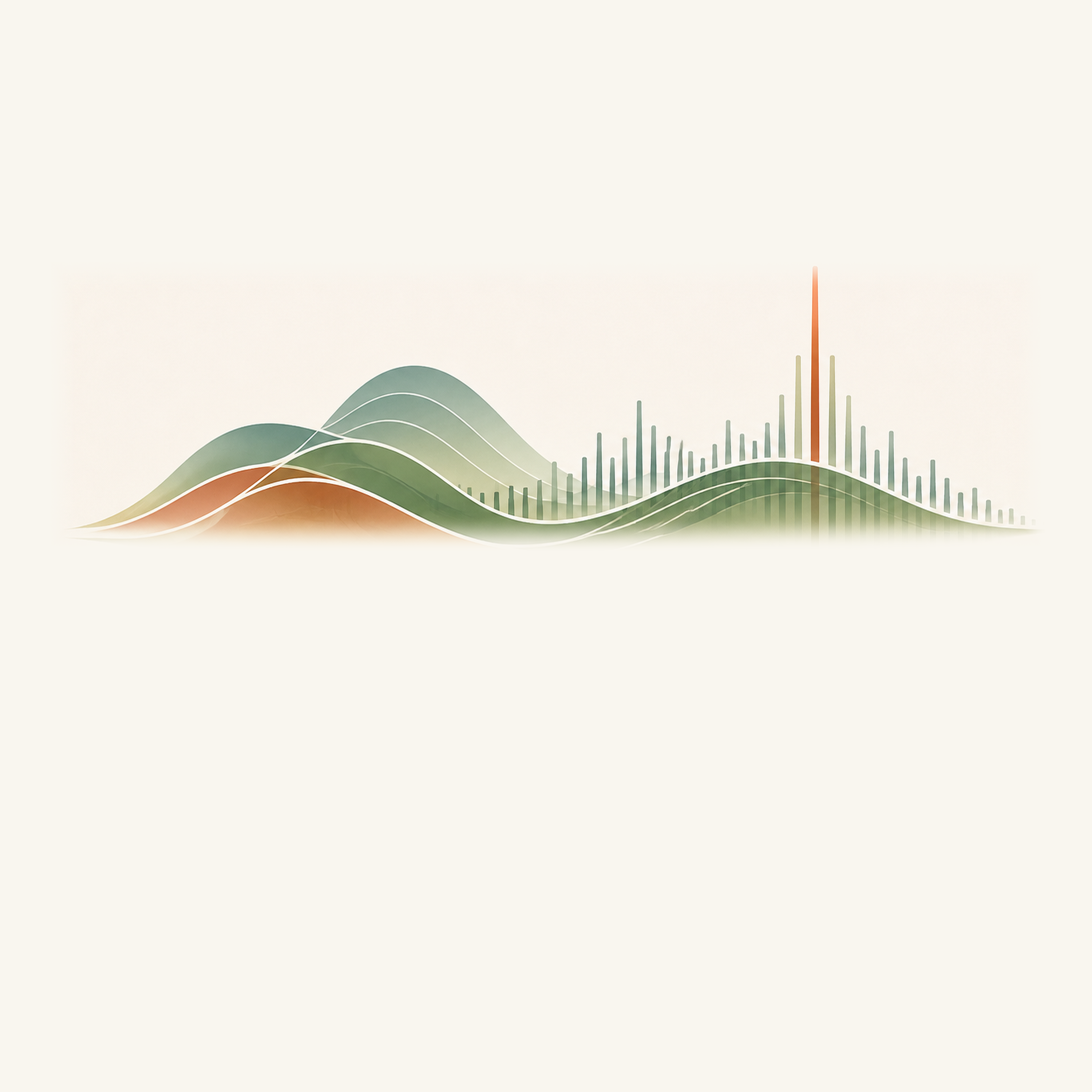
What the analyzer helps us see
Illustrative graphic · not measured dataIn the Evidence Lab, we'll use actual output from the FrequencyScapes analyzer.
Can you make beautiful music around a particular frequency?
This is where the musician in me gets interested.
It's one thing to generate a tone at an exact frequency. It's another to build an engaging piece of music that gives that frequency a meaningful presence—without making the whole experience feel like a laboratory experiment.
That's the creative challenge behind my FrequencyScapes compositions. I make the music, analyze the finished recording, listen, and learn. Sometimes the results surprise me.
For me, the best part is that the music still has to work as music.
Original FrequencyScapes music will live alongside the educational material.
Now the fun really starts.
Once you know what to listen for, familiar frequency labels become interesting questions. The Field Guide explores the numbers; the Evidence Lab explores actual recordings.
The Field Guide is now open. Evidence Lab remains a preview.